


GUIDANCE FOR YOUR FUTURE

The OpenClaw Story #1: From Weekend Project to 100,000 GitHub Stars
Opening Scene
It started with a simple problem.
Peter Steinberger was away from home, sitting in a café, when he realized he needed to check something on his computer back in his apartment. Nothing critical—just a status check, a quick look. But he couldn't. There was no easy way to reach into his own machine from his phone.
"I wonder if I can build something that lets me do this through WhatsApp," he thought.
One hour later, he had a working prototype. A small tool that connected his computer to a messaging app. He shared it online, mostly so he wouldn't lose the code. A few people noticed. A few more forked it. Then he went to bed.
He had no idea what was about to happen.

The Explosion
Within weeks, that personal project became a global phenomenon.
We're not talking hundreds or thousands of users. We're talking 100,000 GitHub stars, making it one of the fastest-growing open-source projects in history.
To put that in perspective: that's more stars than React. More than Vue. More than tools that entire companies are built on.
Two million people visited the website in a single week.
The tech world was buzzing. Developers who had never heard of this project were suddenly seeing it everywhere—on Twitter, on Reddit, in their GitHub feeds. Something was clearly happening, but no one could quite articulate what. It was just... a tool. A simple tool. Why was it spreading like wildfire?
The answer would come soon enough, but first, there was drama.

The Name Drama
The project originally launched as "Clawdbot" —a combination of "claw" (for the lobster theme) and "bot" (for the automation). The "Claude" part was coincidental, or so Peter thought.
But Anthropic, the company behind the Claude AI model, saw it differently. Their legal team sent a polite but firm letter: this name was too close to their trademark. They weren't threatening a lawsuit—yet—but they made it clear a change would be wise.
So Peter rebranded. The new name: "Moltbot."
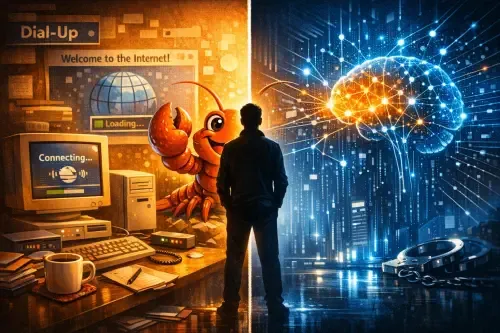
Molt—when a lobster sheds its shell to grow. Perfect metaphor, right? The project was shedding its old identity, growing into something bigger. The community loved it.
Then came the nightmare.
Within hours of announcing the name change, hackers moved with terrifying speed. They grabbed the old "Clawdbot" social media handles. They launched a fake cryptocurrency called "$CLAWD." They built a convincing website, wrote a whitepaper full of AI buzzwords, and started pumping the coin.
In an incredibly short time—minutes, really—that fake coin hit a $16 MILLION market cap.
Then, just as fast, it crashed to zero. A classic "rug pull" scam. Thousands of developers, excited about the project and eager to be part of its growth, lost real money.
Peter was devastated. He hadn't created the coin. He hadn't endorsed it. But his project's name had been used to steal from his community.
One final change was necessary. He needed a name that was legally safe, that represented what the project had become, and that couldn't be hijacked.
The answer: OpenClaw.
"Open" for the open-source community now driving it forward. "Claw" to keep the lobster identity that everyone loved. It was perfect.
Why This Story Matters to You
Here's what this story tells us:
This isn't a corporate product with a marketing budget.
OpenClaw didn't spread because some company spent millions on advertising. It spread because developers voted with their attention. They saw something valuable, something that solved a real problem, and they shared it with each other.
This is grassroots.
And when something spreads this fast in the tech world, it eventually reaches every industry. Including yours. Think back to the late 1990s. Remember the people who said, "The internet is just a fad. I don't need a website." Remember what happened to them.
Think back to 2010. Remember the people who said, "Social media is for kids. I don't need a Facebook page." Remember what happened to them.
Think back to 2018. Remember the people who said, "I don't need an email list. I'll just use social media." Remember what happened when algorithms changed overnight.
Every wave looks like a fad until it becomes the foundation.
The systeme.io Connection
You're reading this on TECHguy, a site built for systeme.io users. So let me connect the dots for you directly.
Remember when you first discovered systeme.io? Remember how it felt to realize you could build an entire business—websites, email sequences, funnels, memberships—all in one place, without hiring developers?
That was a shift.
Before systeme.io, building an online business required technical skills or deep pockets. After systeme.io, anyone with a good idea and some determination could make it happen. The barriers crumbled.
OpenClaw represents another shift.
But this one is different. systeme.io made marketing tools accessible. OpenClaw is making automation intelligence accessible.
The same way systeme.io let you build websites without knowing code, OpenClaw is beginning to let you build AI agents without knowing machine learning. Agents that can act. Agents that can connect your systems. Agents that can work while you sleep.
And just like with systeme.io, the people who understand this shift early will have an enormous advantage.

The Question You're Probably Asking
"So what is it, really?"
That's the question everyone's asking. And in our next post, we'll answer it—clearly, simply, without technical jargon.
We'll explore what OpenClaw actually does, why developers are so excited about it, and what it could mean for your systeme.io-powered business.
But for now, I want you to sit with this story.
A lone developer built something useful. It spread like wildfire. Hackers tried to destroy it. The community survived. And now, a movement is born.
Something is happening.
And if you're a systeme.io user who wants to stay ahead of the curve, you need to understand it. Not because you need to install it today. Not because you need to become a developer. But because this is the shape of things to come.
The question isn't whether AI will affect your marketing.
The question is whether you'll understand it before it arrives.
What's Next
In Blog Post #2, we'll answer the question everyone's asking: "What actually is OpenClaw?" We'll use simple analogies, real examples, and—most importantly—show you exactly why this matters to a systeme.io user like you.
Subscribe to TECHguy on YouTube, so you don't miss it. The next post drops in a week.
The future is coming either way. The only question is whether we face it informed and prepared.
See you in a week!
— TECHguy

Located in the Swedish part of Finland - Available World-Wide
TECHguy is a brand operated by Ab Söderholms IT-tjänster Oy.
Registered in Finland